

Business downtime is the primary financial risk during a commercial relocation. Precision Moving Company, a licensed and insured provider in Somerville, MA, mitigates this risk through phased office relocation strategies and dedicated project managers. This guide covers how to structure your move to keep operations running and protect your revenue.
Phased Office Relocation
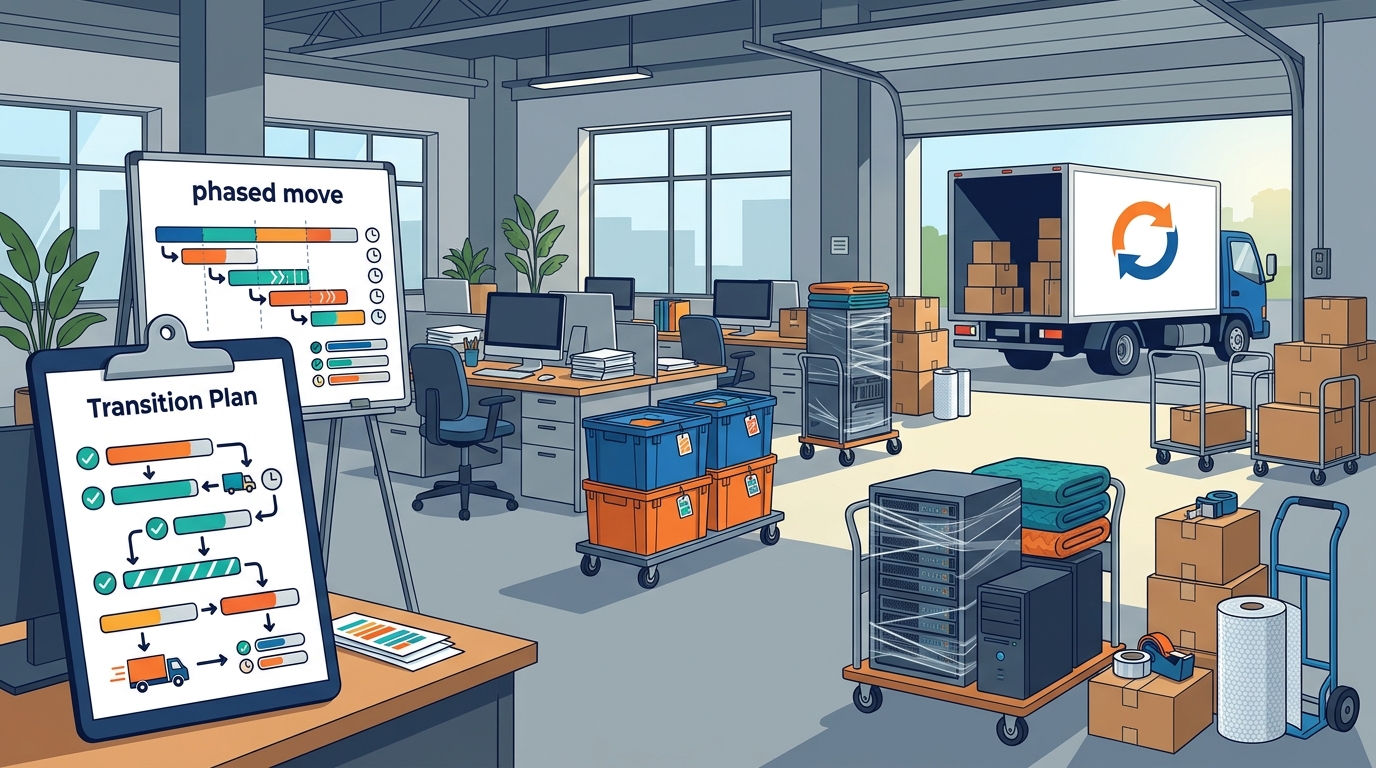
Phased office relocation is a strategic approach that moves a business in distinct stages rather than a single overnight event. This method allows departments to transition sequentially, ensuring that critical workflows remain active while other areas are being packed and transported. By breaking the move into manageable chunks, you avoid the total operational shutdown that often accompanies traditional full-scale relocations.
Structuring the Move by Department
The most effective phased moves prioritize departments based on their operational criticality. You should begin with non-essential administrative functions or departments that can work remotely during the transition. As the move progresses, you shift focus to core revenue-generating teams. This sequencing requires a detailed inventory of assets and a clear understanding of inter-departmental dependencies. For example, if the IT department must be set up before the sales team can access their CRM, the IT phase must be completed and verified before the sales phase begins.
Managing Inventory and Asset Tracking
Accurate inventory control is the backbone of a successful phased move. Professional commercial moving teams use organized inventory management strategies to keep assets accounted for throughout every stage of the move. Detailed labeling systems and item tracking methods ensure that materials arrive where they belong. This level of organization minimizes disruptions and supports a smoother transition. Businesses benefit from knowing that important assets remain properly managed from departure to arrival, reducing the time spent searching for misplaced equipment at the new location.
Minimizing Workflow Interruptions
When a move is phased, the goal is to keep the business running at a reduced but functional capacity. This requires careful planning of utility connections, internet setup, and physical workspace readiness. Each phase should conclude with a "go-live" verification where the moved department confirms that all necessary tools and furniture are in place. This verification step prevents cascading delays where one department's incomplete setup blocks the next department's start date. Precision Moving Company specializes in these complex logistics, ensuring that every phase is executed with the precision required to maintain business continuity.
Dedicated Project Managers
A dedicated project manager is a single point of contact who oversees the entire commercial relocation process from planning to completion. This role is critical for minimizing downtime because it centralizes communication, resolves logistical conflicts in real-time, and ensures that all vendors and internal teams are aligned. Without a dedicated manager, businesses often face fragmented communication where different movers, IT specialists, and facility managers provide conflicting updates, leading to confusion and delays.
The Role of Pre-Move Planning
The foundation of a well-timed relocation begins with comprehensive pre-move planning led by a project manager. An initial consultation allows movers to gather critical details about the scope of the move, including property size, special items, access limitations, and preferred timelines. By collecting this information early, moving companies can tailor services to the client’s specific needs rather than relying on one-size-fits-all assumptions. This planning stage is particularly important because many relocations are tied to major life events such as job changes or family transitions. In a commercial context, this means the move is often driven by business growth or strategic positioning, making efficiency paramount.
Coordinating Specialized Equipment
Many businesses rely on equipment that requires special care during transportation. Computers, servers, medical devices, manufacturing tools, and other specialized assets need specific handling protocols. A dedicated project manager ensures that these items are identified early and that the appropriate protective materials and transport methods are arranged. Professional commercial moving teams use advanced expertise to handle these assets, understanding how to create structured relocation plans that account for these variables. Their experience helps businesses stay organized and focused throughout the transition process, ensuring that high-value equipment is not just moved, but installed and tested correctly.
Real-Time Problem Solving
Even with the best planning, unexpected issues arise on moving day. A dedicated project manager acts as the primary problem solver, making rapid decisions to keep the schedule on track. Whether it is a delayed delivery of new furniture or a technical issue with server racks, the manager coordinates the response. This immediate attention prevents small issues from escalating into major delays. By having a single authority figure managing the logistics, the business leadership can focus on their core responsibilities rather than getting bogged down in the operational details of the move.
Comparison of Moving Approaches
| Approach | Downtime Risk | Complexity | Best For |
|---|---|---|---|
| Single-Overnight Move | High | Low | Small offices with minimal IT infrastructure |
| Phased Relocation | Low | High | Large enterprises with critical workflows |
| Hybrid Model | Moderate | Moderate | Mid-sized businesses with mixed needs |
Key Takeaways
- Phased office relocation allows departments to move sequentially, maintaining operational capacity throughout the transition.
- A dedicated project manager serves as the single point of contact, centralizing communication and resolving conflicts in real-time.
- Accurate inventory control and detailed labeling are essential for tracking assets in a multi-phase move.
- Pre-move planning must account for inter-departmental dependencies to prevent cascading delays.
- Specialized equipment such as servers and medical devices requires specific handling protocols and protective materials.
- Business downtime is a financial risk that can be mitigated through strategic scheduling and professional coordination.
- Verification steps after each phase ensure that moved departments are fully operational before the next phase begins.
- Choosing a licensed and insured moving company with commercial experience is critical for protecting business assets.
Frequently Asked Questions
How does phased moving reduce business downtime?
Phased moving reduces downtime by allowing the business to operate at a reduced capacity while only a portion of the office is being moved. Instead of shutting down the entire company for a single day, you move departments one by one. This ensures that critical workflows remain active and revenue-generating activities continue uninterrupted.
What is the role of a dedicated project manager in a commercial move?
A dedicated project manager oversees the entire relocation process, acting as the single point of contact for all vendors and internal teams. They handle pre-move planning, coordinate specialized equipment handling, and solve real-time problems on moving day. This centralization of authority prevents communication breakdowns and ensures the move stays on schedule.
Can a small business benefit from phased relocation?
While phased relocation is most common for large enterprises, small businesses with critical IT infrastructure or specialized equipment can also benefit. If a single day of downtime would significantly impact revenue, a phased approach or a hybrid model can help mitigate that risk by spreading the workload over a longer period.
How do professional movers handle specialized equipment?
Professional movers use advanced expertise and specific protective materials to handle specialized equipment. This includes custom crates for fragile items, climate-controlled transport for sensitive electronics, and trained crews who understand the proper lifting and securing techniques for high-value assets. They ensure that equipment is not just transported, but installed and tested correctly at the new location.
What is the importance of inventory control in a commercial move?
Inventory control is essential for tracking assets during a move, especially in a phased relocation. Detailed labeling systems and item tracking methods ensure that materials arrive where they belong. This prevents confusion and slows the setup process at the new location, ensuring that businesses know exactly where their important assets are at all times.
How can I minimize the risk of delays during a commercial move?
To minimize delays, you should engage in comprehensive pre-move planning with a dedicated project manager. This involves identifying all assets, mapping out inter-departmental dependencies, and creating a detailed schedule with time buffers for unexpected challenges. Clear communication and thorough planning are the key to keeping the move on track.
Conclusion
Minimizing business downtime during a commercial relocation requires a strategic approach that balances operational continuity with logistical efficiency. By utilizing phased office relocation and engaging a dedicated project manager, you can transform a potentially chaotic transition into a structured, predictable process. Precision Moving Company offers the expertise and resources necessary to execute these complex moves, ensuring that your business assets are protected and your operations remain intact. To plan your visit, contact our team for a personalized consultation on your commercial relocation needs.